

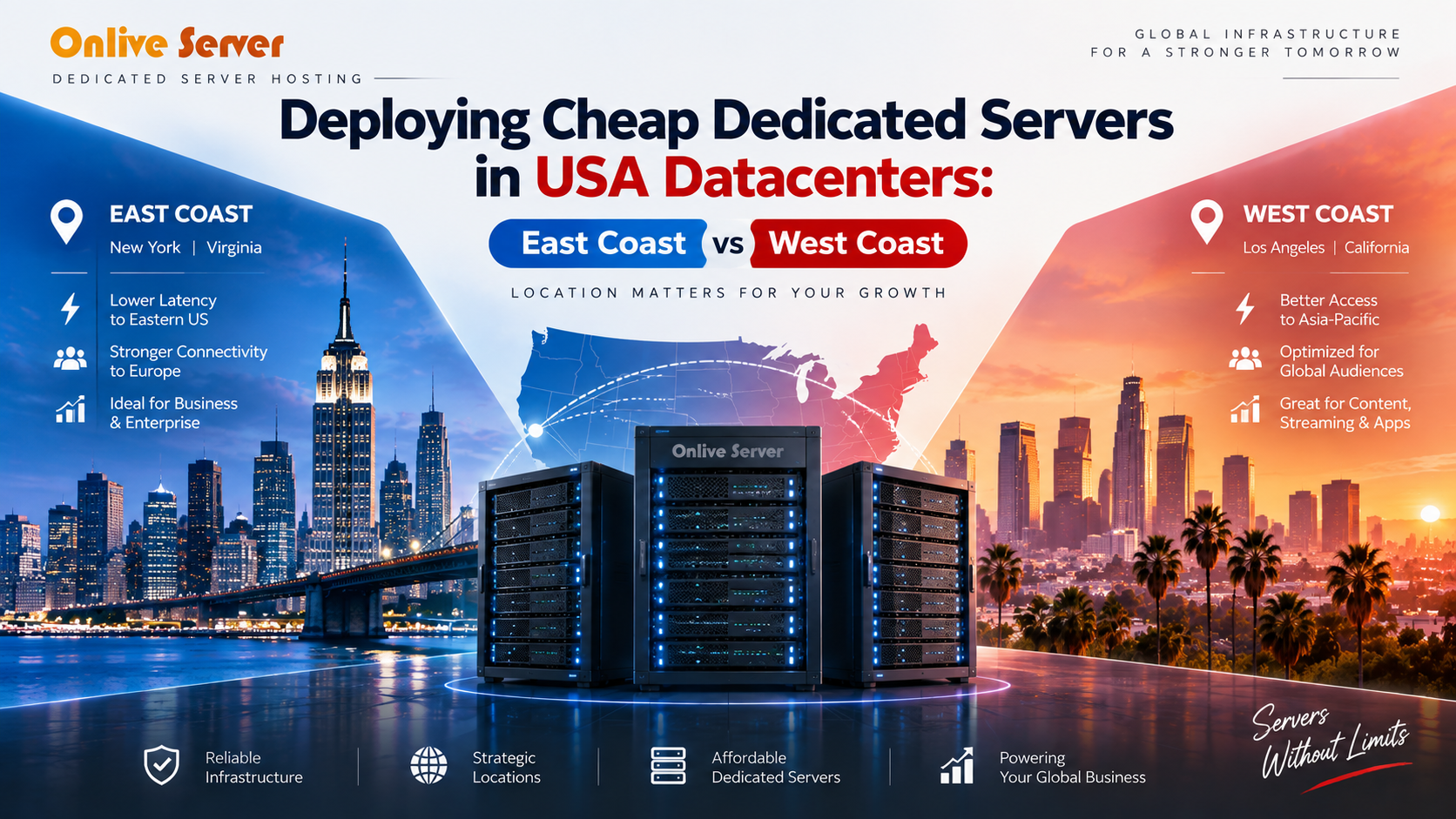
Choosing between US East Coast and West Coast dedicated servers depends on your target audience: East Coast datacenters (Northern Virginia, New York) deliver ultra-low latency to Europe (65–75ms) and the US East, making them ideal for transatlantic finance and SaaS; West Coast datacenters (Los Angeles, Silicon Valley) provide superior transit across the Pacific Rim, Australia, and Asia. For national coverage across the entire US, central locations (Dallas, Chicago) offer balanced 25–40ms latency coast-to-coast.
- Choose East Coast (Ashburn, VA / NYC): If your audience is concentrated in Europe (London ~68ms), Latin America (via Miami NAP), or the high-density US East Coast corridor.
- Choose West Coast (Los Angeles / Silicon Valley): If you need direct transpacific subsea links to the Asia-Pacific (Tokyo ~95ms, Sydney ~130ms) and Western US tech corridors.
- Choose Central US (Dallas / Chicago): For a cost-effective single-server strategy delivering balanced 30–38ms latency across both American coasts.
Across the North American continent, light traveling through terrestrial fiber takes approximately 65 to 75 milliseconds for a round trip between New York and Los Angeles. For latency-sensitive SaaS platforms, financial trading platforms, video streaming CDNs, and multiplayer game servers, locating bare metal in the wrong coastal region introduces friction that degrades customer retention. For verified technical specifications and deployment parameters, consult the official Linux Kernel Documentation.
While sandbox environments can run comfortably on budget VPS hosting server solutions, high-throughput enterprise applications demand bare-metal hardware housed in Tier-III, carrier-neutral US datacenter hubs.
1. The 3 Pillars of US Datacenter Geography
A strategic hosting setup across the United States depends on three geographic routing pillars:
2. Detailed Regional Analysis: East Coast vs. West Coast
A. East Coast Datacenters (Ashburn, New York, Atlanta, Miami)
Northern Virginia (Ashburn) is globally recognized as “Data Center Alley,” where approximately 70% of global internet traffic transits. Hosting on the East Coast delivers unmatched fiber density to the Eastern US population, sub-75ms transatlantic fiber transit to the UK and Western Europe, and low-latency subsea routes into Latin America via the NAP of the Americas in Miami. Explore hardware advancements in our guide to the future of budget bare metal hosting.
B. West Coast Datacenters (Silicon Valley, Los Angeles, Seattle)
West Coast facilities in Santa Clara (Silicon Valley) and Los Angeles (One Wilshire) act as the primary digital gateway into the Asia-Pacific (APAC) region. Connected directly to major transpacific submarine cable systems (FASTER, Jupiter, Unity), West Coast bare-metal servers achieve the lowest possible round-trip latency to Japan (95ms), South Korea (110ms), Australia (130ms), and Western North America’s tech corridor.
3. Premier US Carrier Hotels & Internet Exchange Ecosystems
The backbone of North American telecommunications centers on premier carrier hotels hosting hundreds of autonomous networks:
- Equinix Ashburn Campus (DC1–DC16): The central routing nexus of Northern Virginia, featuring high-density cross-connects to virtually every major Tier-1 transit provider and cloud hyperscaler.
- One Wilshire (Los Angeles, CA): The premier Pacific gateway facility, terminating transpacific subsea fiber cables connecting North America with Tokyo, Hong Kong, and Sydney.
- 350 E Cermak (Chicago, IL) & Infomart (Dallas, TX): Massive carrier hotels linking the Great Lakes financial trading circuits with Southern continental fiber backbones.
4. Overcoming the Transcontinental Latency Barrier
When engineering high-availability dedicated infrastructure for a national user base, adopt these architectural patterns:
- Dual-Coast Geo-Redundant Clusters: Deploying active-active dedicated server clusters in Ashburn and Los Angeles ensures sub-25ms response times across the entire US population.
- BGP Anycast Routing: Using Anycast IP routing, incoming client traffic automatically resolves to the geographically closest datacenter node without brittle DNS geolocation tricks.
- Cross-Coast Disaster Recovery: Asynchronous database replication between East and West coast facilities guarantees operational continuity during regional outages. Review our enterprise backup framework in disaster recovery planning and system backups.
5. Coast-to-Coast Bandwidth-Delay Product (BDP) Tuning
Synchronizing data stores across a 70ms transcontinental link requires calculating the Bandwidth-Delay Product (BDP) to prevent TCP buffer stalls:
- The BDP Calculation:
BDP = Bandwidth (bits/sec) × Round-Trip Time (sec). Over a 1 Gbps link with 70ms RTT, the BDP is 8.75 Megabytes. - TCP Window Buffer Sizing: Setting
net.ipv4.tcp_wmemandnet.ipv4.tcp_rmemto at least 16MB allows TCP connections to fully saturate 1 Gbps lines without pausing for acknowledgement packets. - Private Inter-Datacenter MTU 9000: Enabling Jumbo Frames across dedicated Layer-2 backbone connections reduces CPU interrupt overhead by over 75% during database replication.
6. US Regulatory Compliance & Physical Datacenter Security
Regulated industries require verifiable physical security and operational compliance across American datacenter facilities:
- HIPAA & HITECH Compliance: Mandatory for healthcare platforms, requiring hardware-encrypted NVMe storage at rest, dedicated VLANs, and granular audit trails.
- SOC 2 Type II & SOC 3 Certification: Third-party audits verifying operational security, data confidentiality, and facility availability.
- PCI-DSS Level 1 Compliance: Ensures physical hardware isolation and strict perimeter firewall control for processing payment cards.
- High-Tier Physical Controls: Multi-factor biometric access, mantrap portals, and 24/7/365 armed perimeter surveillance.
7. US Regional Latency Benchmark Matrix (Average Round-Trip Time RTT)
Compare real-world round-trip network latency from major US datacenter hubs to national and international markets:
| Target Destination / Market | East Coast (Ashburn, VA) | West Coast (Los Angeles, CA) | Optimal Deployment Hub |
|---|---|---|---|
| New York / Boston / Washington D.C. | ~2 – 8 ms | ~68 – 74 ms | East Coast (Ashburn) |
| London (UK) & Western Europe | ~68 – 75 ms (Transatlantic) | ~135 – 145 ms | East Coast (Ashburn) |
| San Francisco / Seattle / LA | ~65 – 72 ms | ~2 – 12 ms | West Coast (Los Angeles) |
| Tokyo (Japan) & Seoul (Korea) | ~160 – 175 ms | ~95 – 110 ms (Transpacific) | West Coast (Los Angeles) |
| Sydney / Melbourne (Australia) | ~210 – 230 ms | ~130 – 142 ms | West Coast (Los Angeles) |
| Chicago / Dallas (Midwest & South) | ~20 – 28 ms | ~32 – 38 ms | Central Hub (Dallas / Chicago) |
8. Linux Network Latency & Throughput Diagnostics
Audit latency, path hops, and TCP window behavior between your locations using these production commands after connecting to your server via SSH:
9. Real-World Case Studies: US Datacenter Deployments
Case Study A: FinTech Trading Desk Drops Lag to 1.4ms
A financial analytics firm deployed dual AMD EPYC bare-metal servers in Northern Virginia with direct cross-connects to Equinix NY4. Order execution lag dropped from 45ms to 1.4ms, unlocking massive trading volume scalability.
Case Study B: Enterprise SaaS Deploys Dual-Coast Cluster
A workflow automation platform deployed synchronized dedicated server clusters in Ashburn and Los Angeles. National average page load times dropped below 22ms for all US users. Plan deployments with our guide on releasing your web applications on dedicated servers.
10. Top 3 Pitfalls in US Datacenter Selection
📌 Frequently Asked Questions (FAQ)
Q Should I choose East Coast or West Coast dedicated hosting for European visitors?
Q Can a single server in Dallas or Chicago effectively serve the entire United States?
Q What enterprise hardware features does Onlive Server provide in US datacenters?
Conclusion: Aligning US Datacenter Selection with Target Audience Latency
Selecting the right US datacenter location directly influences user engagement, search engine rankings, and application conversion rates by minimizing round-trip packet travel times.
Deploying dedicated bare-metal servers in strategic US hubs allows businesses to deliver lightning-fast digital experiences. Onlive Server operates high-speed US dedicated server deployments with direct BGP route optimization.
11. Conclusion: Optimize Your US Server Footprint
Whether you require the massive global interconnectivity and transatlantic speed of Ashburn on the East Coast or the direct transpacific gateway into Asia-Pacific from Los Angeles on the West Coast, deploying enterprise dedicated bare metal guarantees optimal compute power, predictable operating costs, and rock-solid network uptime.
Deploy your high-performance cheap dedicated servers in USA with Onlive Server today to take advantage of Tier-III infrastructure, multi-homed BGP routing, and 24/7 expert hardware support.
