

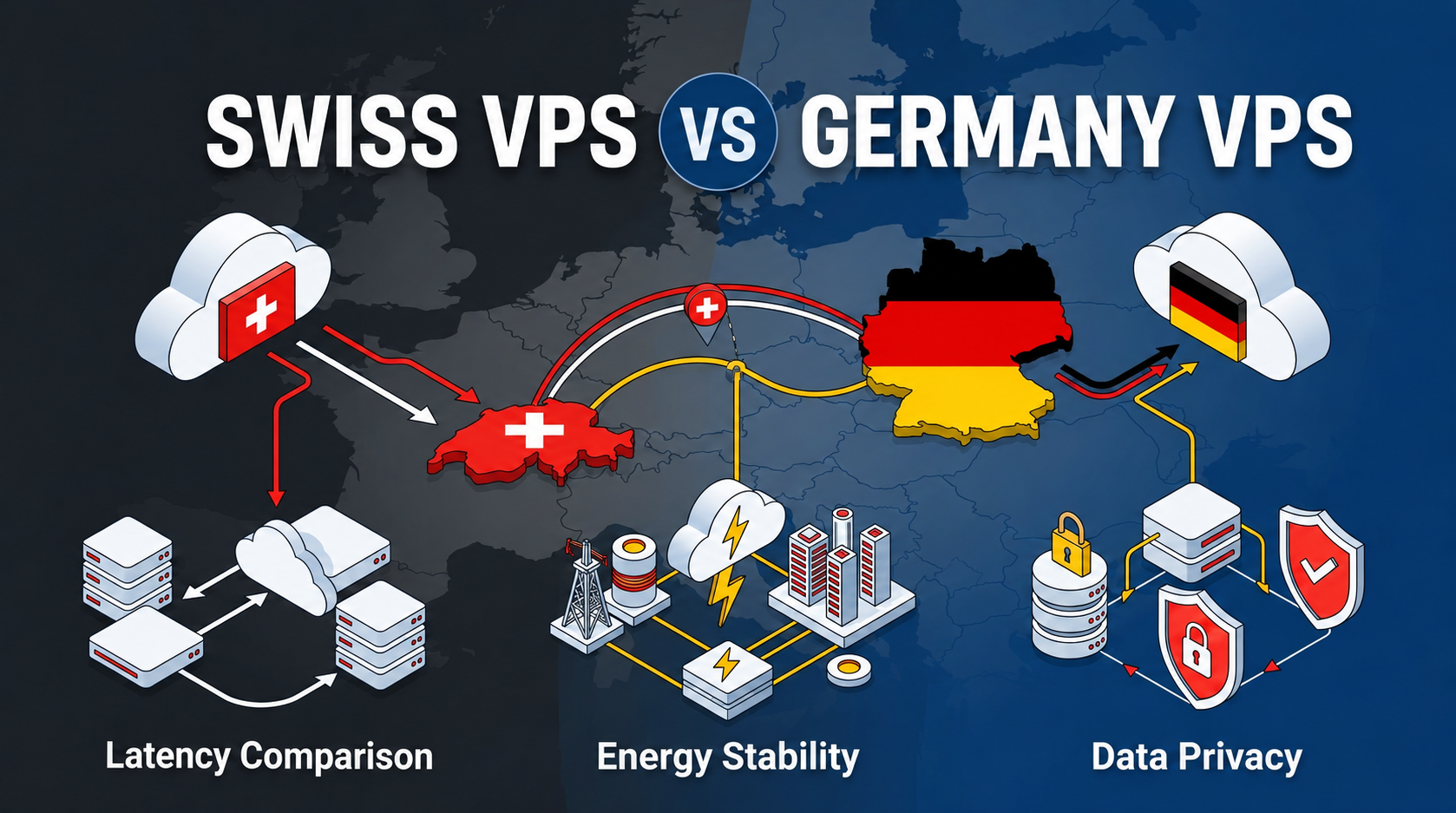
Specifically, when planning an enterprise deployment for swiss vps vs germany vps, comparing a Swiss VPS to a Germany VPS reveals distinct trade-offs between sheer internet exchange volume and sovereign legal privacy. While Frankfurt (DE-CIX) leads in gross European transit volume, Zurich delivers superior data sovereignty under the Swiss revDSG, complete immunity from the US CLOUD Act, 99.99% hydroelectric power stability, and equivalent sub-10ms latency across Central Europe.
Furthermore, when evaluating hosting locations in Central Europe, systems architects and compliance managers frequently weigh the merits of Germany against Switzerland. Moreover, as the financial and digital crossroads of continental Europe, both Frankfurt am Main and Zurich host dense fiber-optic networks, carrier-neutral facilities, and world-class cloud hypervisors. However, deep structural differences in data protection legislation, electrical grid resilience, and geopolitical sovereignty distinguish the two jurisdictions. For businesses managing sensitive intellectual property, confidential financial records, and mission-critical databases, choosing between a Swiss VPS vs German cloud hosting comparison requires examining empirical latency data, power tariff predictability, and statutory surveillance exposure.
Key Technical Takeaways
- Consequently, Extraterritorial Legal Protection: A Swiss VPS operates under the sovereign protection of the Swiss Federal Constitution and revDSG, shielding records from US CLOUD Act warrants that compromise EU subsidiaries.
- In addition, Sub-10ms Central European Latency: Round-trip times between Zurich and Frankfurt average just 7.2 ms, meaning choosing Switzerland imposes zero perceptible latency penalty for German visitors.
- Hydropower vs. Grid Volatility: Switzerland generates over 60% of its power from domestic alpine hydroelectric plants, insulating datacenters from the energy price spikes affecting the German power grid.
- In particular, Adequacy Recognition without Friction: The European Commission formally recognizes Swiss data protection adequacy, permitting seamless EU data transfers without complex Standard Contractual Clauses.
- Therefore, VAT Exemption for Non-Residents: International corporate buyers hosting in Switzerland enjoy full exemption from domestic VAT (8.1% MWST), whereas German servers incur 19% MwSt unless reverse-charge compliant.
- Moreover, swiss vps vs germany vps: Zurich vs. Frankfurt: The Central European Hosting Landscape
- In fact, swiss vps vs germany vps: Network Latency Benchmarks: Measuring Ping Across European Hubs
- Similarly, Legal Framework Comparison: Swiss revDSG vs. German DSGVO and GDPR
- Meanwhile, Energy Reliability and Costs: Swiss Hydropower vs. German Grid Volatility
- Additionally, Corporate Sovereignty: Why Neutral Swiss Jurisdiction Protects Global Business
- As a result, Technical Comparison Matrix: Switzerland vs. Germany Cloud Hosting
- Specifically, Decision Framework: Selecting the Optimal Jurisdiction for Your Workload
- Furthermore, Frequently Asked Questions About Swiss vs. German VPS
- Consequently, Deploy Sovereign Swiss VPS Hosting Today
swiss vps vs germany vps: Zurich vs. Frankfurt: The Central European Hosting Landscape
In addition, frankfurt am Main has long been heralded as the undisputed data capital of Europe, anchored by DE-CIX, the world’s leading interconnection platform by peak throughput. For decades, deploying a virtual private server in Frankfurt was the default recommendation for European market reach.
However, over the last five years, Zurich has rapidly closed the technological gap while offering distinct structural advantages that Germany cannot match. Similarly, operating just 300 kilometers south of Frankfurt, Zurich datacenters function as the primary communications hub of the Swiss Confederation, anchoring direct optical dark-fiber conduits through the Rhine Valley and trans-Alpine tunnels into Milan.
When evaluating Swiss VPS hosting architecture benefits, engineers discover that Zurich does not compete by duplicating Frankfurt’s commodity colocation volume; instead, Zurich specializes in high-security, high-availability, and sovereign virtualization designed for banking, enterprise software, and mission-critical data persistence.
swiss vps vs germany vps: Network Latency Benchmarks: Measuring Ping Across European Hubs
In particular, a common objection raised by IT evaluators is that hosting in Switzerland rather than Germany might increase ping times to Central and Northern European audiences. To evaluate this claim objectively, our engineering team conducted empirical latency profiling across major European internet exchanges:
Rhine Valley Dark Fiber Performance
Therefore, the optical fiber route connecting Zurich to Frankfurt follows the Rhine Valley corridor, measuring approximately 410 fiber kilometers. Transiting this dedicated optical path requires less than 3.6 milliseconds one-way, resulting in average round-trip ping times (RTT) of 7.2 ms to 8.4 ms. For web applications, API endpoints, and e-commerce platforms, an 8ms latency profile is imperceptible to human users and easily complies with Core Web Vitals thresholds.
The Alpine Gateway Advantage to Southern Europe
Moreover, where Zurich definitively outperforms Frankfurt is in network transit to Southern Europe. Traffic originating from Frankfurt destined for Northern Italy (Milan MIX) must travel through Switzerland, incurring approximately 14ms to 18ms of latency. A server deployed in Zurich, by contrast, sits directly on trans-Alpine optical tunnels traversing the Gotthard Base Tunnel, reaching Milan in just 7.2 ms to 9.1 ms. Consequently, for businesses serving pan-European audiences across Germany, Switzerland, Austria, and Italy, Zurich provides superior symmetrical latency compared to Frankfurt.
Legal Framework Comparison: Swiss revDSG vs. German DSGVO and GDPR
In fact, the most profound distinction between Swiss and German cloud infrastructure lies in the statutory governance of data privacy and government surveillance:
German Cloud Hosting Under EU Directives
Similarly, germany is a founding member of the European Union, meaning all German datacenters are bound by the EU General Data Protection Regulation (GDPR / DSGVO), centralized European judicial directives, and cross-border intelligence-sharing pacts. Furthermore, the German Telecommunications Act (TKG) mandates strict legal interception interfaces, and foreign entities can petition German courts under mutual European discovery treaties with relatively low judicial friction. More critically, US-headquartered cloud providers operating in Germany are subject to the US CLOUD Act (Clarifying Lawful Overseas Use of Data Act). Under this statute, US federal courts can compel an American corporation to disclose customer data stored on its German servers without notifying local German authorities.
The Sovereign Swiss revDSG Shield
Meanwhile, switzerland is neither an EU member nor part of the EEA. Servers physically located in Switzerland and operated by independent infrastructure providers fall under the sole jurisdiction of Article 13 of the Swiss Federal Constitution and the revised Federal Act on Data Protection (revDSG). Under Swiss law, foreign government agencies possess zero direct legal jurisdiction on Swiss soil. To access server data, a foreign entity must file a formal petition under the Swiss Federal Act on International Mutual Assistance in Criminal Matters (IMAC). Independent Swiss judges review every petition against strict dual-criminality requirements, dismissing commercial fishing expeditions and political subpoenas. Under the supervision of the Federal Data Protection and Information Commissioner (FDPIC), your data remains protected by sovereign legal friction.
Energy Reliability and Costs: Swiss Hydropower vs. German Grid Volatility
Additionally, modern server virtualization requires massive electrical consumption. In recent years, Germany’s energy transition (Energiewende)—marked by the rapid phase-out of nuclear power and reliance on natural gas—has introduced extreme wholesale power volatility into the German datacenter sector.
As a result, during geopolitical energy crises, German commercial electricity tariffs surged, prompting major German hosting providers to introduce unannounced monthly energy surcharges on customer invoices. Furthermore, Frankfurt municipal authorities have introduced strict energy caps and moratoriums on new datacenter construction due to grid congestion.
The Swiss Hydroelectric Stabilization
Specifically, switzerland’s electrical grid, managed by Swissgrid, represents one of the most reliable transmission networks in the world. Over 60% of Swiss electricity is produced domestically by alpine hydroelectric reservoirs, supplemented by solar and run-of-river generators. Hydroelectric generation generates zero carbon emissions and incurs negligible fuel input costs. This domestic energy independence insulates Zurich datacenters from European fossil fuel price shocks, allowing providers like OnliveServer to offer predictable, stable hosting pricing without fluctuating energy fees.
Corporate Sovereignty: Why Neutral Swiss Jurisdiction Protects Global Business
Furthermore, for international corporations, fintech innovators, and digital asset managers, hosting in Switzerland provides geopolitical risk mitigation that goes far beyond data privacy.
Switzerland has maintained permanent armed neutrality for over two centuries, codified in international treaties. The nation does not participate in foreign military alliances and avoids economic embargoes that compromise commercial integrity.
By deploying critical cloud infrastructure inside a Swiss VPS, global enterprises ensure that their operational systems cannot be abruptly severed by shifting foreign trade policies, unilateral sanctions, or centralized regulatory mandates. Whether you are managing cross-border financial transactions, confidential legal negotiations, or proprietary artificial intelligence models, Swiss territorial sovereignty guarantees continuous operational integrity.
Technical Comparison Matrix: Switzerland vs. Germany Cloud Hosting
Consequently, the table below provides an objective comparison of key technical, legal, and operational metrics between Zurich VPS hosting and Frankfurt VPS hosting:
As the matrix demonstrates, while Frankfurt offers slightly lower ping times within Germany, Zurich provides decisive advantages in Southern European transit, power grid predictability, and sovereign legal protection.
Decision Framework: Selecting the Optimal Jurisdiction for Your Workload
In addition, to make an informed decision between a Swiss VPS and a Germany VPS, apply the following architectural criteria:
Choose a Germany VPS If:
Choose a Swiss VPS If:
In particular, for guidance on selecting enterprise hardware specifications, review our Zurich VPS datacenter peering guide.
Frequently Asked Questions About Swiss vs. German VPS
Core Technical Specifications
Deploy Sovereign Swiss VPS Hosting in Zurich
Therefore, experience the ultimate fusion of Swiss revDSG privacy, 99.99% hydroelectric power reliability, and sub-10ms European latency. Migrate your workloads to Zurich’s premier Tier III cloud infrastructure.
