

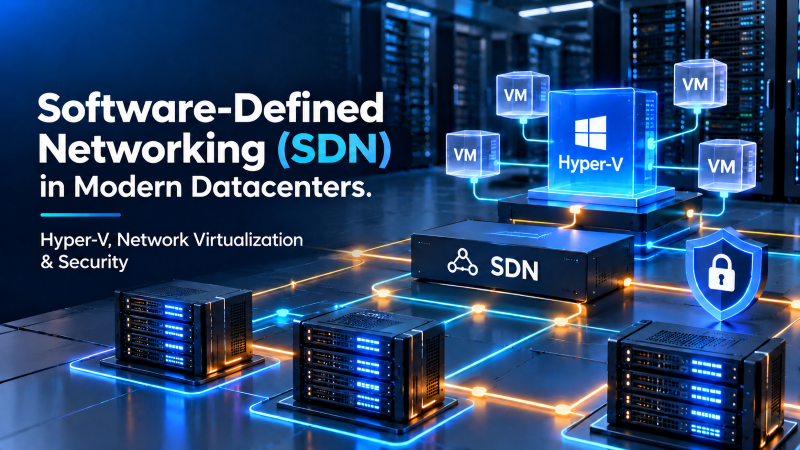
Software-Defined Networking (SDN) decouples network control logic from physical switching hardware, solving four critical datacenter challenges: 1) VLAN exhaustion (overcoming the 4,094 VLAN limit using 16-million VXLAN/NVGRE virtual network IDs), 2) Complex multi-tenant network isolation, 3) Rigid hardware provisioning bottlenecks, and 4) East-West security vulnerabilities. By centralizing network orchestration via software controllers, SDN enables granular microsegmentation, automated virtual load balancing, and dynamic multi-tenant routing across physical host servers.
Modern enterprise datacenters face unprecedented network scalability demands. As cloud computing, containerization, and microservices proliferate, traditional physical network architectures—reliant on manual switch port reconfigurations and static VLAN tags—have become major operational bottlenecks.
Software-Defined Networking (SDN) fundamentally transforms datacenter operations by separating the control plane (which decides where traffic is routed) from the data plane (which physically forwards packets). This decoupling allows administrators to programmatically orchestrate complex virtual networks in seconds.
Deploying virtualized Windows environments on an enterprise high-performance Windows VPS enables organizations to leverage native Hyper-V network virtualization and granular access controls.
Four Critical Datacenter Challenges Solved by SDN
1. Overcoming the 4,094 VLAN Scalability Ceiling: Traditional 802.1Q networking restricts datacenters to 4,094 VLAN tags. In modern multi-tenant cloud environments where thousands of client virtual networks coexist, this limit is quickly breached. SDN uses VXLAN (Virtual Extensible LAN) or NVGRE encapsulation, expanding the network identifier space to over 16 million unique virtual subnets.
2. Eliminating East-West Security Vulnerabilities: Traditional network firewalls guard the perimeter (North-South traffic entering and exiting the datacenter). However, once an attacker breaches an internal virtual machine, they can move laterally between servers without triggering firewall inspections. SDN introduces distributed microsegmentation firewalls directly at the virtual network adapter level, enforcing Zero Trust rules between VMs on the same physical host.
3. Dynamic Software Load Balancing: Hardware load balancers are expensive and represent single points of failure. SDN integrates distributed software load balancing (SLB), distributing incoming web and application traffic across virtual machine pools dynamically without hardware appliances.
4. Automated Multi-Tenant Isolation: Enterprises often manage multiple independent departments or external clients on the same physical infrastructure. SDN ensures complete cryptographic and logical isolation between tenant virtual networks, even when different clients utilize overlapping private IP ranges (such as 10.0.0.0/24).
For organizations requiring dedicated bare-metal infrastructure to host private SDN fabrics or custom hypervisors, deploying an enterprise bare-metal dedicated server delivers unthrottled hardware throughput and full root access.
Traditional Networking vs. Software-Defined Networking
| Architectural Dimension | Traditional Physical Networking | Software-Defined Networking (SDN) |
|---|---|---|
| Network Segmentation | VLANs (Capped at 4,094 IDs) | VXLAN / NVGRE (16+ Million VNI tags) |
| Provisioning Speed | Days to weeks (Manual switch cabling) | Seconds (Automated API scripts) |
| Lateral Security Enforcement | Weak (Open East-West traffic flow) | Zero Trust microsegmentation at virtual vNIC |
| Load Balancing Architecture | Proprietary hardware appliances | Integrated software-distributed load balancers |
| IP Address Flexibility | Rigid (Subnets tied to physical switches) | Total (Bring-Your-Own-IP overlay networks) |
Enterprise Implementation: Hyper-V and Network Controller Architecture
In modern enterprise environments, Microsoft Windows Server (from 2016 through 2022 and 2025) provides robust built-in SDN capabilities via the Network Controller role. The Network Controller provides a centralized REST API endpoint that programs Hyper-V Virtual Switches across thousands of server nodes.
Administrators define high-level security policies and routing intents. The Network Controller pushes OpenFlow or OVSDB instructions to each host, ensuring that even if virtual machines migrate across physical cluster nodes during live migration, their IP addresses, firewall rules, and encryption policies move with them seamlessly.
Consulting with an experienced certified systems engineer helps IT leadership design, test, and deploy resilient SDN architectures that modernize legacy datacenter operations.
Decoupling the Control Plane from the Data Plane
Software-Defined Networking (SDN) represents a fundamental paradigm shift in enterprise datacenter architecture. In legacy network topologies, control logic and packet forwarding are tightly coupled within proprietary, vendor-locked switches and routers.
SDN decouples the decision-making control plane from the underlying packet-forwarding data plane. By centralizing network intelligence within software controllers, administrators can programmatically provision, route, and secure complex multi-tenant networks without physically re-cabling switch ports.
Architectural Comparison: Legacy vs Software-Defined Networks
Analyzing architectural capabilities reveals why modern cloud hosting infrastructures rely entirely on software-defined fabrics.
- Centralized Programmability: Manage network-wide routing tables, QoS bandwidth policies, and firewall rules via centralized REST APIs.
- Elimination of Spanning Tree Bottlenecks: Replace restrictive Spanning Tree Protocol (STP) limits with Equal-Cost Multi-Path (ECMP) routing for full fabric utilization.
- Automated Micro-Segmentation: Enforce zero-trust security policies between virtual machines residing on the exact same physical hypervisor chassis.
- Dynamic Traffic Engineering: Programmatically reroute latency-sensitive application traffic around congested physical switches in real time.
Network Virtualization: VXLAN Overlays and Hyper-V Network Controller
Traditional IEEE 802.1Q VLANs are strictly capped at 4,096 distinct network segments—a limitation that catastrophic limits multi-tenant cloud scale. Software-Defined Networking overcomes this boundary using Virtual Extensible LAN (VXLAN) encapsulation.
VXLAN encapsulates standard Layer 2 Ethernet frames inside Layer 4 UDP packets, expanding the theoretical network segment ceiling to over 16 million unique virtual networks. In environments like Windows Server Hyper-V and Linux Open vSwitch, the centralized Network Controller manages routing tables across all physical hypervisor nodes seamlessly.
Key SDN Deployment Capabilities
Enterprise network controllers unlock advanced operational capabilities essential for massive virtualization clusters.
- Software Load Balancing (SLB): Distribute incoming HTTP and TCP connections across application pools using high-performance kernel-mode multiplexers.
- Distributed Datacenter Firewalls: Apply granular stateful packet inspection at the virtual network adapter level before packets hit the physical network.
- Multi-Tenant Gateway Routing: Provide high-throughput BGP routing and site-to-site IPsec VPN tunnels connecting private tenant clouds to on-premises networks.
- Quality of Service (QoS) Guarantees: Reserve minimum bandwidth allocations for storage replication while preventing rogue tenants from saturating physical uplinks.
Operational Agility and Automated Infrastructure as Code (IaC)
The true operational power of SDN manifests when integrating network provisioning directly into DevOps automation pipelines. Using Infrastructure as Code tools like Terraform, Ansible, and PowerShell DSC, engineers can define entire multi-tier network topologies alongside virtual server deployments.
Spinning up isolated development environments, staging testing subnets, and production database perimeters takes seconds rather than weeks of manual switch configuration. This agility accelerates software release velocity while eliminating human configuration errors.
DevOps Integration Checklist
Following proven SDN deployment patterns ensures network reliability and automated security enforcement.
- Automated Network CI/CD: Validate network configuration changes through automated unit testing before applying policies to live network controllers.
- Real-Time NetFlow/sFlow Telemetry: Stream granular flow telemetry to centralized SIEM dashboards for instant security anomaly detection.
- Zero-Touch Provisioning: Automatically assign IP subnets, routing gateways, and security groups whenever new virtual nodes are spawned.
- Immutable Network Policies: Store declarative network state files in version-controlled Git repositories for complete audit compliance and rapid rollbacks.
BGP Peering and Border Gateway Integration in Software-Defined Networks
Connecting software-defined virtual datacenter overlays to the global internet requires sophisticated Border Gateway Protocol (BGP) routing integration. Modern SDN gateways establish dynamic multi-homed BGP peering sessions directly with upstream internet service providers.
Through dynamic route advertisements, virtual tenant subnets can fail over across disparate physical datacenter locations automatically. If a primary datacenter circuit experiences disruption, BGP routes automatically redirect incoming traffic to secondary SDN gateway clusters without manual DNS reconfiguration.
- Automated Route Advertisements: SDN controllers dynamically announce virtual IP prefixes to upstream core routers using standard BGP sessions.
- Equal-Cost Multi-Path (ECMP): Distribute ingress traffic across multiple redundant SDN gateway appliances to eliminate single-device throughput bottlenecks.
- Multi-Region Virtual WAN: Interconnect geographically separated datacenter clusters into a unified software-defined wide area network.
- Stateful Gateway Failover: Active-standby gateway pairs synchronize connection states in real time, preventing dropped TCP sessions during hardware failovers.
Conclusion: Building Future-Proof Infrastructure with SDN
Software-Defined Networking has fundamentally transformed modern datacenter management by replacing rigid, proprietary hardware topologies with programmable, agile virtual network fabrics. Decoupling the control plane from underlying forwarding switches grants organizations unprecedented visibility, automation, and granular security control.
Through VXLAN encapsulation, distributed firewalling, and automated API-driven provisioning, SDN empowers enterprises to scale thousands of isolated multi-tenant workloads effortlessly. Embracing software-defined network architecture ensures your cloud hosting infrastructure remains agile, secure, and ready to meet future enterprise challenges.
Frequently Asked Questions
What is the primary difference between SDN and traditional networking?
Traditional networking couples routing decisions with physical hardware switches. SDN decouples the control plane (software management logic) from the data plane (hardware packet forwarding), allowing programmatic network automation.
How does VXLAN solve the 4,094 VLAN limitation?
VXLAN encapsulates Layer 2 Ethernet frames inside standard Layer 3 UDP packets and uses a 24-bit Virtual Network Identifier (VNI), expanding the available isolated network segments from 4,094 up to 16,777,216 unique subnets.
What is microsegmentation in an SDN environment?
Microsegmentation applies firewall filtering rules directly at the virtual network interface card (vNIC) of each individual virtual machine, preventing infected VMs from communicating laterally with other servers on the same subnet.
Does Software-Defined Networking add latency to network packets?
No. Modern Network Interface Cards (NICs) support hardware offloads (such as Single Root I/O Virtualization – SR-IOV and VXLAN Task Offload), processing packet encapsulation directly in silicon with zero measurable latency impact.
Can SDN be used to connect multiple geographically separated datacenters?
Yes! SDN gateways establish encrypted software-defined WAN (SD-WAN) overlays across public internet or private MPLS links, allowing virtual machines in different global datacenters to communicate as if they were on the same local switch.